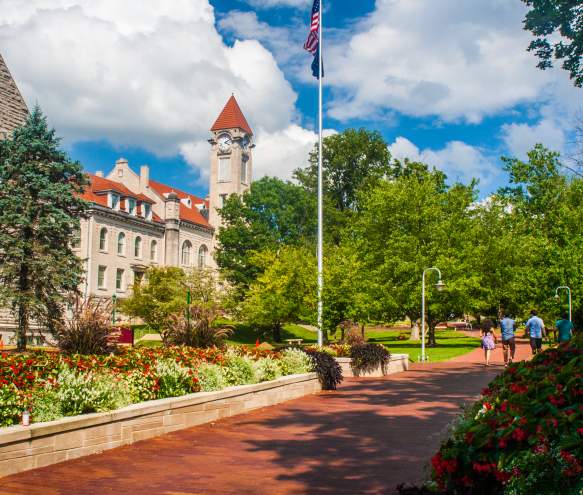
The McKinney fountain was a monumental symphony of splashing water inside the bustling Indiana University campus
By Mike Leonard
A bittersweet back to school experience awaits students, faculty, staff and the public familiar with the McKinney fountain in front of the Simon Music Center on the Indiana University campus.
The widely admired fountain, or almost all of it, is gone. Silenced, knocked down, excavated and currently looking like the repair site of a waterline break on a city street.
IU says the 29-year-old fountain had exhausted its useful life, and it’s hard to believe that a fountain built in 1997 with $700,000 of donated money bought a beautiful fountain with the lifespan of a Ford truck. There are reasons that people view the demolition with raised eyebrows and a poignant ache.
“I had no idea it was so beloved,” says Frank McKinney, the son of the late Frank McKinney, Jr., for whom the fountain was named. Like other members of the McKinney family, he received no notice from IU that the aesthetically impressive fountain was not only going to be razed but was, in fact, already a former fountain. The family isn’t happy about that, but neither are they motivated to cause a fuss. “Much of it was non-dedicated funding (bequeathed to the university by Frank McKinney Jr.) that IU could have been used for anything so there was no violation of donor intent,” McKinney says. “But, still, a little notice would have been nice.”
Those McKinney funds, an estimated $250,000-$400,000, were apparently tapped and combined with a commensurate donation to the project from the wife of the deceased, Marianne W. Tobias. McKinney Jr. and the former Marianne Hardison Williams married in 1989, three years before McKinney died in a mid-air plane collision in 1992. She went on to marry Eli Lilly & Co. CEO Randall Tobias in 1995.
Marianne met to discuss her vision for the water sculpture with IU President Thomas Ehrlich, Jacobs School of Music Dean Charles Webb, IU Foundation President Curtis Simic and Vice President and Chief Administration Officer Terry Clapacs. A celebrated classical pianist who could note post-doctoral work with IU’s esteemed pianist and professor Menahem Pressler, Tobias imagined the original idea of a fountain featuring the crash of water and sound of competitive swimming that her late husband excelled at but perhaps also paying tribute to music, a shared passion of the couple.
The concept behind the fountain’s ultimate design deserves a standing ovation. A long, curved limestone retaining wall held a line of water jets that rose and fell to various heights at different times, like the music from an orchestra pit, where clarinets and trumpets, timpani and oboes pipe up at unexpected times. A good 20 feet away, a thick limestone column gurgled water from the top while a central crown spun, imitating the sweeping baton of a conductor calling out the broad and subtle sounds of the music.
For a work of art on that scale to act as a metaphor for the music nurtured and produced by the world class Jacobs School of Music, it was brilliant.
The problem was the problems. The fountain was either leaking water, underpowering the jets or having just about everything that could go wrong going wrong and needing repair or replacement. Unlike the famous fountains of the world that have lasted for decades and even centuries, the McKinney fountain did not operate through a simple gravity-fed system that required a substantial investment in infrastructure. The McKinney fountain used a far cheaper modern system – because new technology often pays dividends – and employed high-maintenance pumps, electrical networks in a damp environment and specialized plumbing. Among other things. Too many things that could go wrong and did.
“Given the time period when it was built, it looks like something you’d see at the Bellagio (in Las Vegas), which was kind of cutting edge back then,” Frank McKinney says. But even at the Bellagio, its fountains don’t have to deal with the freezing, thawing and corrosiveness of a Midwestern winter. The fountain planning was carried out by Tobias and the IU brass without the McKinney family’s participation. Family members say they didn’t even know the fountain existed until being notified it had been torn down.
IU says it plans to make the newly vacated area more plaza-like and a place where students and faculty can read, talk or fidget with their phones. Small-scale performances are also being discussed as another use for the space.
The repairs and modifications to the fine arts district of campus are being rolled into a larger project that includes much needed maintenance to the Musical Arts Center – one of the finest opera houses in the country. It’s that large, strikingly modernist building down the street from the Simon Music Center – the behemoth structure with the bright red and genuine Alexander Calder stabile in the front yard.
And while the single conductor’s column from the old McKinney fountain will remain, the majesty of the fountain, tucked away in a corner of campus, will be remembered wistfully. The Dalai Lama, who has visited the IU campus a few times, often speaks of the impermanence of life, and Buddhist monks are known to create intricate, artful sand mandalas, and then deposit their composition into a body of water to dissipate and rejoin the natural earth.
The hallowed McKinney fountain came and went too quickly. Neither life, nor mankind’s creations, last forever. But surely, the McKinney fountain deserved more than 29 years.
About the Frank McKinneys

The Frank McKinney interviewed for this story prefers to simply go by that name and leave the juniors and Roman numerals behind. Though he was born into a prominent and wealthy family, he left Indiana at age 18 with $50 in his pocket, his biography says. He went on to become a startlingly successful “real estate artist” specializing in design-and-build oceanfront mansions that have sold for an average price of $14 million. He’s run numerous ultramarathons, contributed to the construction of 32 self-sustaining villages in Haiti, and is looking forward to the release of his 10th novel in October.
His father, Frank McKinney Jr., was also born in Indianapolis, an unlikely location for a swimming prodigy who took home a medal from the Pan-American Games at age 16. An adherent of a new wave of backstroke style, he was courted by collegiate swimming powerhouses across the country, but he liked this James “Doc” Counsilman, this new coach down in Bloomington, and believed in his mission to make IU a swimmer’s Mecca.
Under the direction of Counsilman and diving coach Hobie Billingsley, IU went on to win 20 consecutive Big Ten championships and six consecutive NCAA championships. If the university hadn’t been put under what became known as death penalty sanctions because of infractions in the desperate-to-win football program, the number of national titles very likely would have been more. A numbers cruncher once took all of IU’s swimming and diving times and scores at a point in IU swimming’s golden age, compared them to the rest of the world, and in a theoretical head-to-head meet of IU against the planet, IU would have won.
“Dad was a part of the beginning of that legacy,” his son says. “He won gold, silver and bronze medals in Olympic competition. He was proud to be a part of that.”
After college, McKinney Jr. rose to the position of president of American Fletcher National Bank in Indianapolis, and then the head of Bank One of Indiana. If success in big business is the equivalent of swimming with sharks, he must have been good at it.
To take one more step back, Frank E. McKinney, father of Frank Jr., also was a banker and served as chairman of the Democratic National Committee from 1951-52, anointed by President Harry Truman. His tenure is noted for, among other things, advocating a party platform that included requiring that Internal Revenue employees be civil servants rather than patronage workers. The country’s aversion to political patronage held steady for more than 75 years but now is repeatedly challenged by President Donald J. Trump, who values loyalty to him personally.
Frank E. McKinney also was the majority owner of the Pittsburgh Pirates major league baseball team from 1945-50.
The family enjoys an impressive legacy.
“It’s interesting to note that that when Dad decided to go to IU, IU was a nobody in swimming,” his son says. “And then it became a juggernaut.
“Kind of reminds me of Coach Cignetti and what he’s done for IU football,” McKinney says. “They said it couldn’t be done. And now he’s doing it.”