
Pioneering radio show turns over the reins after more than three decades
By Mike Leonard
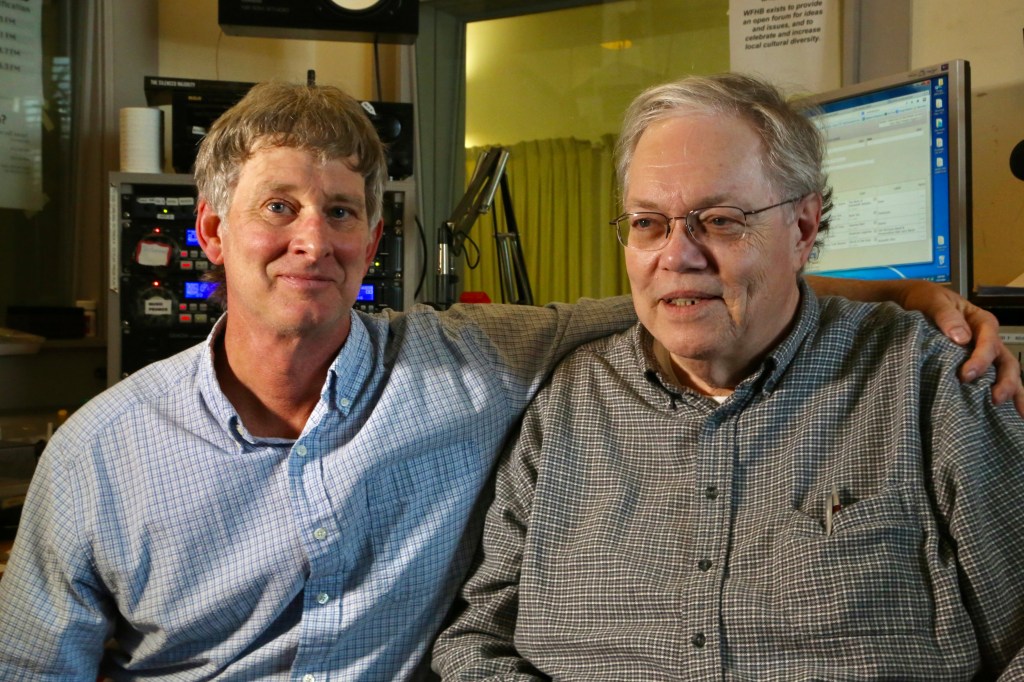
When program host Bill Weaver announced his retirement from the WFHB show, “Dark End of the Street” in late December, fans and friends of the program all seemed to say the same thing: “It’s the end of an era.”
Dark End launched at the same time Bloomington’s community radio station -Indiana’s first such station – entered the airwaves in 1993. ‘Humble beginnings’ doesn’t adequately describe the small, primitive cinder block shack next to the broadcast tower for the station, 11 miles south of Bloomington. Hot in the summer, cold in winter, and inconvenient for every person who signed on to volunteer for the newly created radio station.
The unusual format of “The Best of Old Time Country and Rhythm and Blues” sounded interesting if not enticing, and the Dark End of the Street quickly became one of the most popular destinations on Bloomington’s beloved nonprofit radio station and remained so for more than 30 years.
The musical premise was sound. The roots of rock and roll grew from R&B and early country music. And there was so much of both out there that was never heard outside of the pockets where it was played. A journalism aphorism says: “Show me, don’t tell me.” Dark End did that. Before there were radio stations like WFHB, the format was rare if not singular. The artists didn’t record on major record labels. Commercial radio didn’t have a place for such a thing.
“The more I get older, the more I realize that all of that great R&B made years ago was essentially what became rock and roll,” Weaver says. “(Dark End co-founder) Steve (Thrasher) always knew more about R&B than I did, so I chose the country side to balance his strengths.”
And how did they come up with the name of the show?
“Steve rented a room from me to practice drums,” Weaver recalls. “I was listening to Gram Parsons doing (a country take on the song), “Dark End of the Street,” and Steve already knew the R&B versions. It just hit us that this was the perfect song to illustrate the fusion of the two genres.”
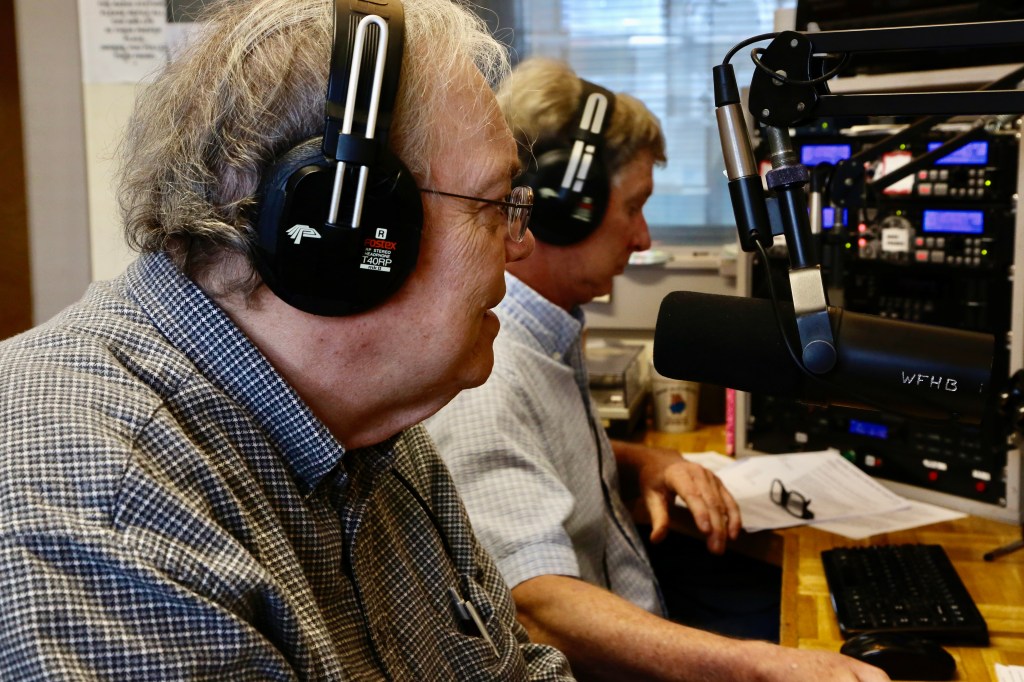
The secret sauce to the radio show was personality driven, not so much by design as the chemistry between the co-hosts.
“The two of them together were such a hoot,” recalls Thrasher’s widow, former Indiana University law school dean, and later, Provost Lauren Robel. “They had overlapping musical interests. But not just overlapping enough, if that makes sense. They complemented each other, both in terms of musical tastes but personalities.”
Weaver already had radio experience on the progenitor of WFHB, the cable station WQAX. His “Rubber Room” show was an underground favorite (OK, everything on cable-limited WQAX could have been called underground.) The Lawrenceburg, Indiana native spoke in a mellow voice, calm and avuncular, and his wit was ready for a poke at any time from Thrasher, who had taken on the moniker of Dr. Raymond Dubose – The Old Professor.
Thrasher was always ready to ask a question or offer a point of view, earnestly, or just to elicit a response. He grew up in Louisiana and Alabama and especially Florence, a neighbor to Muscle Shoals, the revered R&B hotbed. He met his future wife, Robel, when both were students at Auburn University, earned a few degrees along the way, but never cottoned to the academic world as a profession.
Gus and the Old Professor explored pathways that merged at the Dark End of the Street.
“I’ll never forget the pathos versus bathos argument they had on one show. Maybe more,” Robel says. “Steve didn’t have Gus’s tastes for the more camp or schticky side of the street. You know those songs where a teary eyed child is asking mommy and daddy to not get divorced? Gus was okay with taking that Tammy Wynette divorce genre about as far as you could push it. Steve wasn’t.
“Then they debated on air. Did it cross the line from pathos into bathos? Did it fall off the cliff? Of course they didn’t agree.”
Weaver chuckles at the memory. “One time it was like we were fighting on the air and we just kind of went with it and it did sound like we were fighting. When we got off the air we both started laughing because we were friends and while we actually did disagree on some things the whole thing was just us having fun with it,” he says.

Tragedy struck in 2015 when Thrasher was fatally injured by a thundering rogue wave while he was bodyboarding in Hawaii. It was something he’d done hundreds of times. He was very familiar with it. But sometimes lightning strikes.
Beyond the shock and the grief, Weaver said he never considered ending the show. It meant too much to him. And, truth be written, it meant too much to listeners. Saturdays from 2-4 p.m. with Gus and the Professor had become woven into the fabric of Saturday afternoons in the Bloomington area.
After a while, Weaver began inviting guest co-hosts to join him and maybe create a little bit of that interpersonal dynamic he enjoyed so much with Thrasher. That, and to add artists or songs he didn’t know and welcomed learning about.
Three years ago, Weaver suffered a stroke. “If you can say you were lucky in having a stroke, I was in a sense,” he says. “My carotid (artery) was all clogged up and they got me to Methodist Hospital in Indianapolis and I was pretty awake and aware while they were working on me. At one point I heard the doctors talking in serious voices. Later I found out my heart stopped twice. But my brain still works. I can talk OK, and mostly walk, but it damaged my left side and that’s getting worse.”
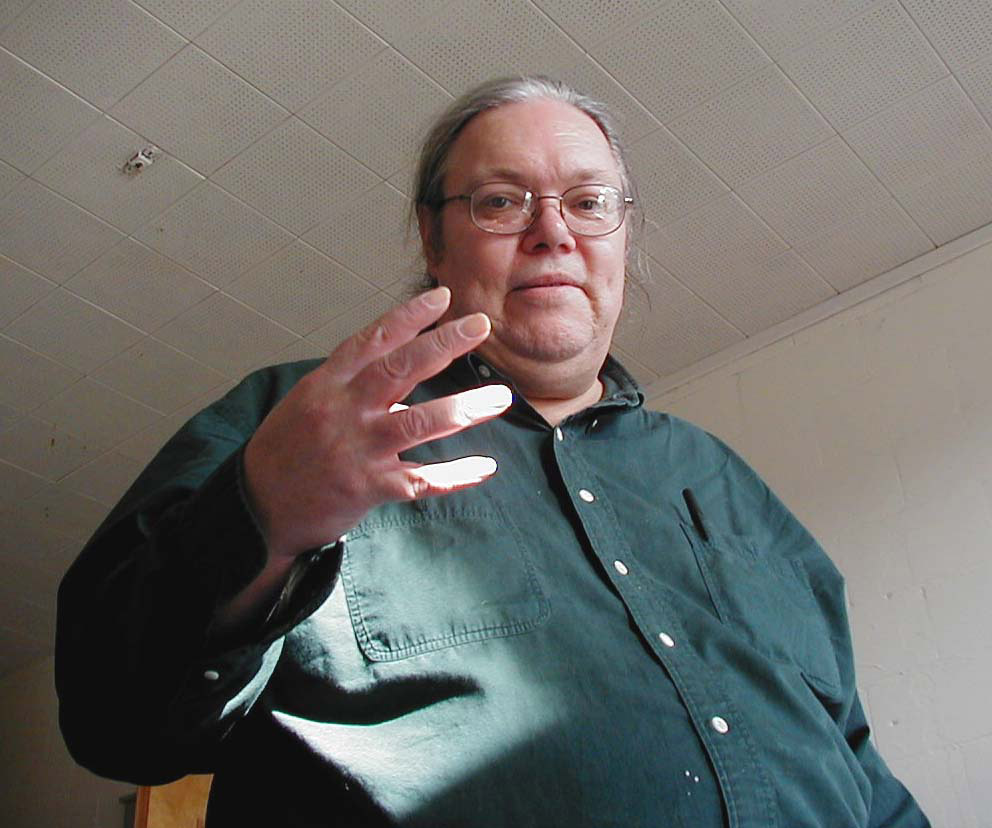
The physical cost of the stroke manifested itself about a year ago, when Weaver was alone at the present WFHB studio in downtown Bloomington. He finished Dark End, started a pre-recorded show on the radio station’s broadcast and took a fall navigating his way through the office. “I fell down and couldn’t get up,” he says, mimicking the once omnipresent television commercial hawking a wearable emergency alert call. Fortunately, a Youth Radio volunteer was in the building. “If I hadn’t gotten lucky I’d have been on that floor for hours if not a day. It was then I realized I couldn’t do a show alone anymore” he says.
Eventually, the 74-year-old Weaver decided that his mobility issues and other factors had gotten to the point where he felt it was time to let go. The program will continue with a rotating crew of hosts, according to general manager Jar Turner. “The theme will be the same but I think there is going to be more soul worked into that mix. Everyone stepping in is a fan of what Gus and the Professor did. It’ll just be tweaked a bit.”

Turner says “It is fair to say it’s been the station’s most popular, or at least one of the most popular shows since it went on the air. That interpersonal give and take is not common on WFHB but they did it so well. There was a lot of dry humor, a few jokes, but it wasn’t like the commercial radio programs that go for laughs. It was subtle and focused on delivering a very good program. They were just very natural on the radio. People who didn’t know them felt like they knew them.”
Robel says her late husband worked a lot harder on the show than people knew. “He’d work on his set list all week before the show. He really thought it through and thought about the flow or maybe a theme for a set. I have hundreds and hundreds of set lists he made over the years.”
Weaver says he also pored over and rethought sets, but there were also times he came in with nothing and put his musical menu together on the spot. “Now, there’s no way in hell I could do that,” he says emphatically, but with good natured self-deprecation, fully accepting the age-old aggravation of old age.
Weaver says he misses making those set lists a lot of times now, but it’s also liberating. When he mines sources for songs and new material, he isn’t bound by the same country lane he’s always taken. “Now I can download Metallica,” he says cheerfully.
Would he actually do that? “No,” he answers quickly. But he admits that he doesn’t seek out country as much as R&B these days. And he doesn’t go fishing for new material as often as he did when he had to feed the beast, as they say. Thirty-plus years of doing so is a hell of a run.
“I always said I was going to do it as long as I could stay in the saddle and ride that horse,” he says. “Now it’s time to ride off into the sunset.”🐝
Clarification: Two edits were made in this story after initial publication. The side of Weaver’s body affected by his stroke was incorrect, as was a quotation about his fall at the radio station.
 The B-Town Bee